


AI Astrology vs Human Astrologer Which Should You Trust
31 Aug 2026 • 1 min read

SanatanAI
Author

 201
201 201
201
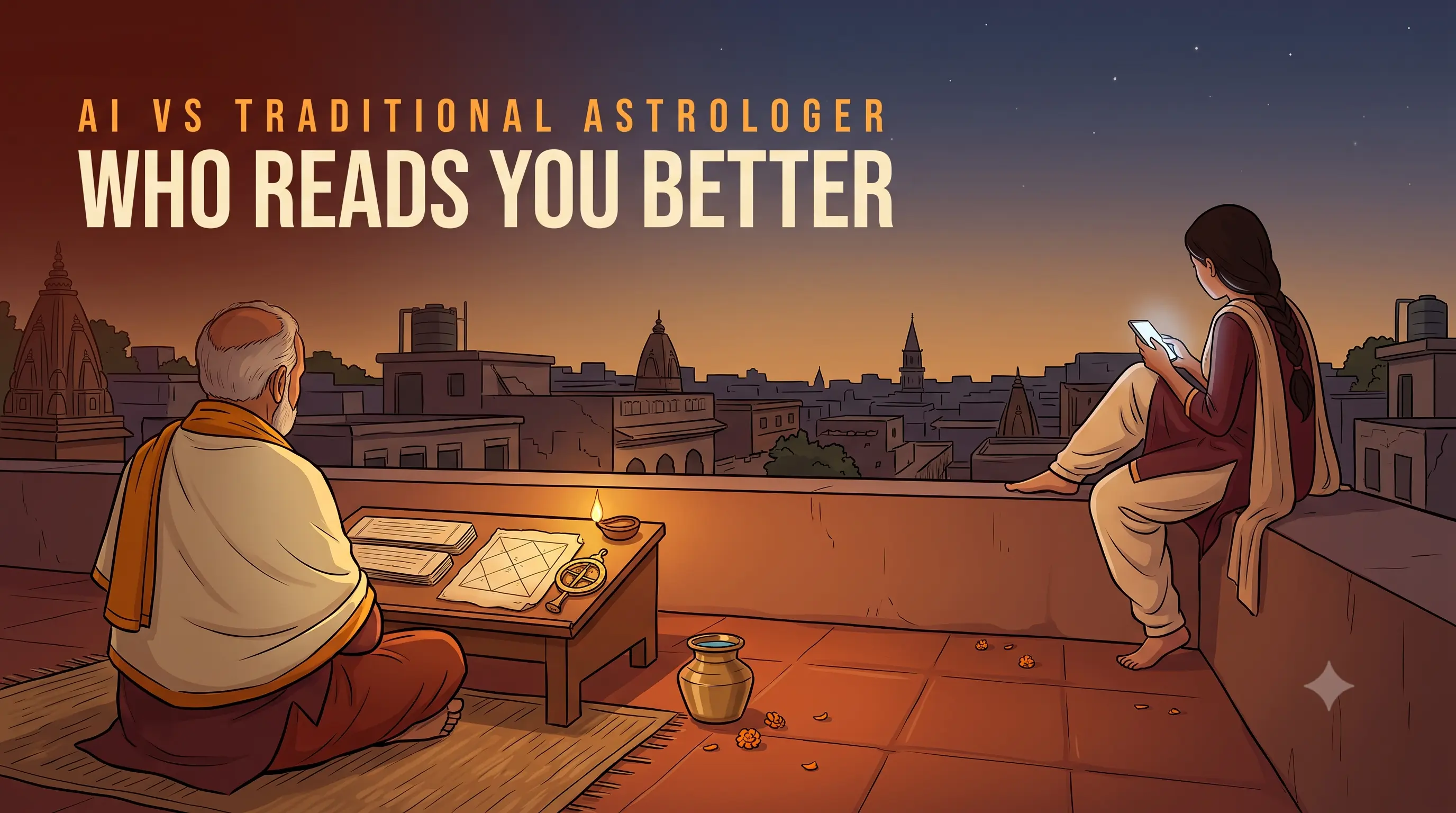
Quick answer
They are strong at different halves of the same work. AI wins on calculation — planetary positions, divisional charts, dasha timelines, 36-point Guna Milan — because that is arithmetic with one correct answer. A human astrologer wins on synthesis and counsel: weighing contradictory indications, reading the person and not just the chart, and knowing when to say less. Use AI for the mathematics and the first layer of reading; use a person for decisions that carry weight. And ignore anyone quoting an accuracy percentage on either side.
Almost every comparison you will find on this question is written by someone with a stake in the answer. Astrology consultancies conclude that humans are irreplaceable. AI apps conclude that AI is now good enough. Both write with conviction and neither offers anything you can check.
We build an AI astrologer and we book human pandits, so we have an interest in both sides — which is a reason to be sceptical of us too. So rather than declaring a winner, this page splits the work into tasks and says plainly which side is better at each, and why.
First, correct the biggest myth in this debate
Several widely shared articles claim AI astrology works by studying thousands of birth charts, finding recurring patterns, and learning which planetary combinations produce which outcomes. One popular explainer describes it as machine learning that "doesn't guess, it learns," forecasting from statistics and probability.
That is not how it works, and it could not be. Training a model to predict outcomes from charts would require a dataset pairing millions of birth charts with verified life events — the marriages, illnesses, job changes and losses that actually happened, confirmed and dated. No such dataset exists. Nobody has collected it.
What an AI astrologer really does is far more ordinary, and more honest: it computes the chart using standard astronomical routines, then applies the interpretive rules of classical texts it was trained on. It is executing a rule system written down centuries ago. It is not discovering one from data. Any platform implying otherwise either misunderstands its own product or is happy for you to.
The comparison, task by task
Once you stop asking "which is better" and start asking "better at what", the picture resolves quickly.
| Task | Who does it better | Why |
|---|---|---|
| Chart calculation, D1 to D60 | AI | Deterministic astronomy. Same answer every time, in under a second, with no arithmetic slips. |
| Dasha and transit timelines | AI | Accurate by hand but laborious. Software produces the full sequence instantly. |
| 36-point Guna Milan scoring | AI | Fixed rules and fixed arithmetic. No interpretation required to reach the number. |
| Detecting yogas and doshas | Comparable | Most are defined configurations. Humans still read edge cases and cancellations more finely. |
| Availability and cost | AI | Any hour, no appointment, near zero cost. No running meter shaping how you ask. |
| Consistency | AI | The same chart yields the same reading. Human readings vary with practitioner and day. |
| Weighing contradictory indications | Human | Charts routinely conflict. Resolving that is pattern sense built over thousands of readings. |
| Reading the person, not the chart | Human | Knowing why you are really asking, and what you have not said. |
| Knowing when to say less | Human | Restraint is a professional skill. Software answers what it is asked. |
| Counsel through a hard decision | Human | Advising two families through a difficult matching result is not a computation. |
| Ritual and remedy execution | Human | A remedy can be described by software. It has to be performed by a person. |
Notice the shape of it: everything above the midpoint is calculation, everything below is judgement. That line, not the technology, is what actually divides the two.
Where they genuinely disagree — and why
People often report that an app and an astrologer gave them different charts, and conclude one must be wrong. Usually neither is. Three ordinary explanations cover almost every case:
Ayanamsa choice
Converting from the tropical to the sidereal zodiac requires an ayanamsa value, and more than one is in respectable use. Different choices shift positions slightly and can move a planet across a sign boundary.
House system
Whole sign, Placidus and others divide the houses differently. A planet can sit in the ninth house under one system and the tenth under another.
Birth time and place
The ascendant moves about one degree every four minutes. A rounded birth time, or a place resolved to the wrong coordinates or historical time zone, changes the chart before anyone interprets it.
None of these is an AI problem or a human problem. They are configuration questions, and the right response to a disagreement is to check the settings rather than to pick a side.
The cost difference, stated plainly
This is where the gap is widest, and it deserves arithmetic rather than a slogan.
Marketplace platforms connecting you to human astrologers charge by the minute. Rates vary by practitioner, and popular astrologers on the larger platforms command a premium. The figures below are illustrative at a common mid-range rate, to show the shape of the difference rather than to quote any particular platform.
| What you want to do | Per-minute consultation | Sanatan AI |
|---|---|---|
| One 10-minute question | around ₹300 | Free |
| Three questions in a month | around ₹900 | Free |
| A question most days | around ₹9,000 | ₹49 / month |
| Follow-up on yesterday's answer | Billed again from zero | Included, with context kept |
| Re-reading the same answer next week | Not possible unless you took notes | Saved in your history |
| Asking the same thing three ways | Billed three times | Included |
Rates on marketplace platforms differ widely by astrologer and change often. Check the current rate before comparing. Sanatan AI plans run from free at three chats a day to ₹49 for fifteen a day, ₹149 for forty and ₹399 for a hundred.
The meter changes the question you ask
The bigger cost is not the money. It is what a running clock does to a consultation.
When you are paying by the minute you compress. You skip the background that would have made the reading better. You do not ask the follow-up that occurs to you thirty seconds later, because the follow-up costs another eighty rupees. You do not admit you did not understand the answer. And you certainly do not come back tomorrow to ask a slightly different version of the same question, which is often how people actually arrive at what they were really asking.
A daily limit removes all of that. Ask badly, then ask again properly. Sit with an answer overnight and return to it. Chase the thread until it makes sense. That is a different quality of consultation, not merely a cheaper one.
Follow-ups, and why they matter more than the first answer
Astrological questions rarely resolve in one exchange. You ask about marriage timing and the answer names your seventh lord and a dasha window — which raises three more questions about what that period actually brings, what to avoid, and which remedy applies. On a per-minute platform each of those is a fresh charge, often in a fresh session with the context lost. On Sanatan AI your chart is already generated and the conversation is already in progress, so a follow-up costs nothing and picks up where you left off.
The questions people will not ask a person
There is a category of question that almost never reaches a human astrologer, and it is often the most important one.
People hesitate to ask about a marriage they are having doubts about, about money trouble they have not told the family, about a relationship the family does not know exists, about whether to leave a job everyone thinks is a good job. In a small town the astrologer may know your parents. Even where they do not, saying certain things aloud to another person is simply hard.
An AI astrologer has a real and underrated advantage here: there is nobody on the other side to face. No pause, no expression, no chance the question travels. You can ask the thing you actually want to know rather than the polite version of it — and because the follow-up is free, you can keep going until you have your answer.
Your conversations on Sanatan AI are private to your account and encrypted, and your chat history is visible only to you. Read the privacy policy for the full detail.
When it turns serious, you are not starting over
Most comparisons treat this as a binary: use the app, or find an astrologer. In practice the useful thing is a path between the two, because questions escalate.
A chart question becomes a marriage decision. A dasha reading becomes a family matter with two sides to advise. A remedy becomes a puja that has to be performed properly, by someone qualified, at the right muhurat. Software cannot perform a Rudrabhishek.
Sanatan AI is built by PujaPurohit, which also runs a verified pandit network. So when a question outgrows the chat, the escalation happens in one place: your chart is already generated, the reading you have been working through is already there, and you are not starting from birth details with a stranger. You can move from an AI reading to a verified pandit or a booked ritual without repeating yourself.
That is the argument for using both, and it is why we are comfortable telling you plainly which side is better at what. We are not asking you to choose one.
Which to use for which question
| Your question | Start with | Escalate to a person when |
|---|---|---|
| What does my chart actually say? | AI | You want a full life reading, not an orientation. |
| When do the good career periods fall? | AI | You are choosing between two concrete offers. |
| What is our Guna Milan score? | AI | The score is low and the families need advising. |
| Do I have Mangal Dosha? | AI | You need to know whether it is cancelled and what follows. |
| What remedy suits this period? | AI | The remedy involves a puja that must be performed properly. |
| Should I marry this person? | Human | Immediately. A chart informs this; it does not decide it. |
| Which muhurat for our ceremony? | AI | The ritual itself needs a pandit — book both together. |
| I am going through something hard. | Human | Immediately, and consider a counsellor alongside. |
What neither can do
Worth stating clearly, because both sides of this market blur it when it suits them.
- Neither can demonstrate predictive accuracy. There is no control group for a life. A percentage figure from an app or a practitioner is a marketing number, not a measurement.
- Neither should answer medical questions. If you are unwell, see a doctor. An astrological reading about your health is not a diagnosis and must not delay one.
- Neither should answer legal or financial questions. Consult a lawyer or a licensed adviser. Anyone predicting your court outcome or your returns has left the territory of guidance.
- Neither can fix a wrong birth time. Garbage in, confident garbage out, on both sides.
How we use both
PujaPurohit runs an AI astrologer and a verified pandit network, and we route between them deliberately. Sanatan AI handles the chart, the dasha timeline, the matching score, the divisional charts and the first layer of interpretation across Vedic, Lal Kitab and KP, in twelve or more Indian languages, with the reasoning shown so you can check it. When the question turns into a decision — a marriage, a ritual, a difficult period — that goes to a verified pandit.
If you want the longer explanation of what the calculation layer involves and why accuracy claims do not hold up, we have written that separately in is AI astrology accurate.
See your own chart before you decide
Generate your kundli, check the planetary positions and dasha periods, and ask one real question. Free to begin, no card required.
Try Sanatan AI freeFrequently asked questions
Is AI astrology better than a human astrologer?
Neither is better overall, because they are strong at different halves of the work. AI is better at calculation: planetary positions, divisional charts, dasha timelines and Guna Milan scoring are arithmetic, and software is faster and does not make slips. A human astrologer is better at synthesis and counsel: weighing contradictory indications in a chart, reading the person asking rather than only the chart, and judging what should be said and what should not. The practical answer is to use AI for the mathematics and the first layer of reading, and a person for decisions that carry weight.
Does AI astrology learn to predict from data?
No, and this is the most widely repeated mistake about AI astrology. Several popular articles claim AI studies thousands of birth charts, finds recurring patterns and learns which planetary combinations produce which outcomes. That is not possible, because no dataset exists linking birth charts to verified life outcomes at scale. What AI actually does is compute the chart using standard astronomical routines, then apply the interpretive rules of classical texts it was trained on. It is applying a rule system, not discovering one.
Is AI astrology accurate compared to a real astrologer?
On calculation, AI and a careful human astrologer reach the same answer, because the mathematics has one correct result. On interpretation, neither can demonstrate accuracy, since a life prediction has no control group to test against. Any platform or practitioner quoting a precise accuracy percentage is marketing rather than measuring. What you can reasonably compare is whether a reading cites checkable reasoning: named houses, lords, dasha periods and chart positions.
Which is cheaper, AI astrology or a human astrologer?
AI astrology is dramatically cheaper. Marketplace platforms typically charge per minute, which for a substantial consultation runs into hundreds or thousands of rupees, and the running meter changes how people ask questions because they rush. Sanatan AI by PujaPurohit is free to start at three chats a day with no card, and paid plans begin at ₹49 for fifteen chats a day. A human consultation still makes sense for a major decision, but not for routine chart questions.
How much cheaper is AI astrology than a human astrologer?
Substantially. At a common per-minute rate, a single ten-minute consultation costs a few hundred rupees, and asking a question most days for a month would run into thousands. Sanatan AI is free at three chats a day, with paid plans from ₹49 for fifteen chats a day. The larger saving is on follow-ups, which are billed again on per-minute platforms but included here, with your earlier conversation and chart retained.
Are my questions to an AI astrologer private?
That is one of the real advantages. There is no person on the other side, so questions people hesitate to say aloud — about a marriage they are unsure of, money trouble they have not disclosed, a relationship the family does not know about — can be asked directly rather than in a softened version. On Sanatan AI your conversations are private to your account and your chat history is visible only to you.
When should I consult a human astrologer instead of AI?
Consult a person when the decision is consequential and irreversible: a marriage, a major ritual, a family matter where two sides need to be advised together, or a moment of genuine distress. Also consult a person when a chart shows contradictory indications and you need someone to weigh them against the specifics of your situation. Use AI for chart generation, dasha timelines, matching scores, learning your own chart and exploring questions before you take them to someone.
Can AI do kundli matching as well as a pandit?
For the scoring, yes. The Ashtakoot Guna Milan total out of 36, along with Mangal Dosha, Nadi and Bhakoot checks, follows defined rules that software computes reliably and instantly. What software handles less well is the judgement around the number: when a low score is offset by other chart factors, when a dosha is considered cancelled, and how to counsel two families through a difficult result. Get the numbers from AI, take the decision to a person.
Do AI and human astrologers use the same calculations?
Broadly yes. Both work from an astronomical ephemeris, apply an ayanamsa to convert to the sidereal zodiac, and derive the ascendant, houses, divisional charts and Vimshottari dasha. Differences between two readings usually come from the ayanamsa selected, the house system used, or an inaccurate birth time, rather than from one side being AI and the other human.
Why do two astrology apps give me different charts?
Almost always because of a different ayanamsa setting, a different house system, or a difference in how the birth place coordinates and historical time zone were resolved. These are configuration choices rather than errors. If two charts disagree meaningfully, check which ayanamsa each uses and confirm that your birth time and place were entered identically in both.
Can an AI astrologer understand my emotions?
It can respond to what you write, and it can do so patiently and in your own language at any hour. What it cannot do is know you over time, read what you are not saying, or take responsibility for the effect of what it tells you. For emotional weight, a person is better. For a difficult question you are not ready to ask a person yet, AI has a real advantage in being private and unhurried.
Should I use AI astrology or a human astrologer for career questions?
Start with AI. Career timing questions map cleanly onto chart factors — the tenth house and its lord, the Dashamsa divisional chart, and the current dasha and transit periods — and AI produces those quickly with reasoning you can check. Take it to a human astrologer when you are choosing between two concrete offers or considering a major change, because that is a weighing decision rather than a calculation.
Related reading
- Is AI astrology accurate? A free AI astrologer guide
- Kashi Vishwanath Sugam Darshan 2026: price, booking and timings
Free to start, no card. Try Sanatan AI

Kajri Teej 2025: Your Complete Guide to Vrat, Rituals, and Celebrations with pujaPurohit
Discover the complete guide to Kajri Teej 2025. Learn about the vrat date, puja muhurat, rituals, and significance of this auspicious festival celebrated for marital bliss. Book a verified pandit for an authentic home puja with pujaPurohit.
.png?alt=media&token=335a7d74-d6c2-4c15-b141-dfb560ef62c5)
दुर्गा पूजा 2023: जानें तिथियां और शुभ मुहूर्त
इस बार नवरात्रि 15 अक्टूबर से शुरू होकर 23 अक्टूबर तक चलेगी।
जानिए कैसे विरोधियों ने ही साबित की सनातन की प्राचीनता ?
जब दुनिया के नए धर्म 'मूर्ति पूजा' को रोकने के नियम बना रहे थे, तब सनातन धर्म पहले से मौजूद था। पढ़ें कैसे इतिहास के पन्नों में छिपा है वैदिक सभ्यता के 'अमर' होने का राज।
Chaitra Navratri 2024: Know the Dates & Mantras for Each Day, Book Purohit for Navratri Puja
Book a pandit for Navratri puja in Banglore, Delhi, Kolkata. Know the dates of chaitra navratri & mantra to chant each day.
Your spiritual need,
just a tap away.

Your spiritual need,
just a tap away.