


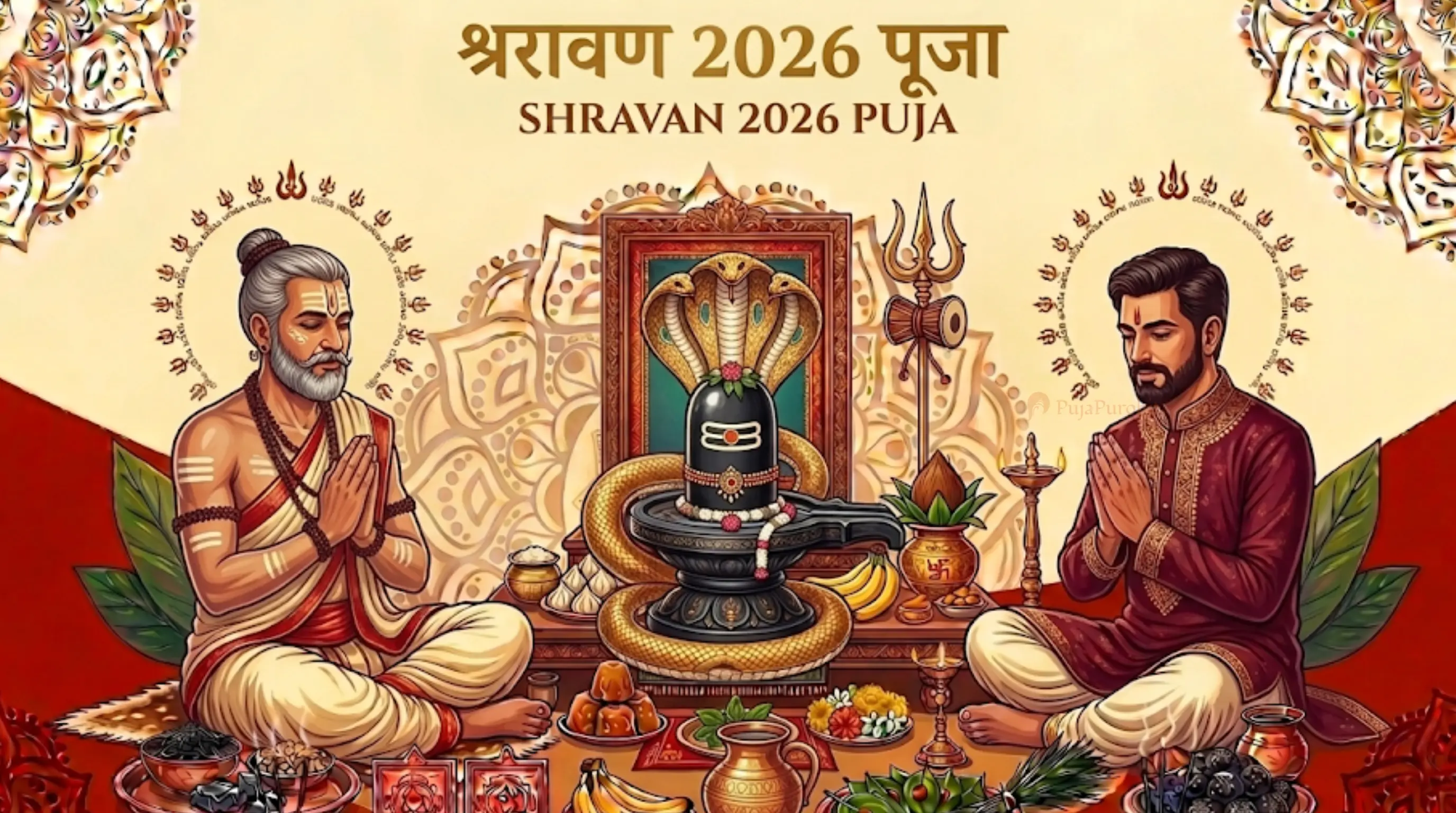



The first drops of monsoon rain on dry earth. The smell of wet soil. Shiva temples overflowing with devotees carrying Gangajal on foot. Married women fasting on Tuesdays. Streets echoing with Har Har Mahadev. Telangana women balancing Bonam pots on their heads in procession. Tamil households drawing kolam before dawn for Aadi vrats. This is Shravan — India's most spiritually alive month.
Whether you call it Sawan in Hindi, Shravan in Sanskrit, Shravana in South India, or Aadi in Tamil Nadu — this sacred month is a convergence of devotion so intense, so geographically diverse, and so deeply woven into Indian family life that no single tradition can claim it alone. This is the master guide for 2026. Every date. Every vrat. Every tradition. North and South together.
Shravan 2026 Dates — North vs South India Explained
The single most confusing thing about Sawan is why the dates differ by almost 15 days between North and South India. Here is the clear explanation.
India's Hindu communities follow two different lunar calendar systems:
North India (UP, MP, Bihar, Rajasthan, Delhi, Punjab, Jharkhand) — Purnimanta Calendar: In this system, each month ends on the Purnima (full moon). The month of Shravan therefore begins on the day after Ashadha Purnima. In 2026, this gives: July 30 to August 28.
South and West India (MH, GJ, KA, AP, TG, TN) — Amavasyant Calendar: In this system, each month ends on the Amavasya (new moon). Since the full moon falls roughly 15 days later in the cycle, Shravan begins later. In 2026: August 13 to September 11.
This is not a discrepancy — it is two equally valid Vedic calendar systems. The spiritual significance of Shravan is identical across both. The Shiva devotion, the Monday fasts, the Rudrabhishek — all are equally valid on both sets of dates.
Why Shravan Is Lord Shiva's Month
During the cosmic churning of the ocean (Samudra Manthan), a lethal poison called Halahala emerged that threatened to destroy all creation. Lord Shiva consumed the poison and held it in his throat, turning it blue. Shiva's body temperature rose dangerously. The other gods poured water and milk over him continuously — the first Jalabhishek. This happened in the month of Shravan. Since then, every drop of rain in this month and every pot of milk poured over a Shivalinga is a continuation of that divine act of gratitude. Sawan is humanity's eternal thank-you to Mahadev.
Sawan Somvar 2026 — All Monday Vrat Dates, Puja Vidhi & Fasting Rules
Every Monday (Somvar) in Shravan is considered supremely auspicious for Lord Shiva worship. Devotees fast, visit temples, perform Jalabhishek, and recite Shiva mantras. Below are all Sawan Somvar dates for both calendars:
| # | Date & Day | Calendar | Key Puja |
|---|---|---|---|
| 1st | Aug 3, 2026Monday | North India | First Sawan Somvar — highest merit. Rudrabhishek + Shiva Sahasranama. |
| 2nd | Aug 10, 2026Monday | North India | Jalabhishek, Bael Patra offering, Shiva Puja at home or temple. |
| 3rd | Aug 17, 2026Monday | Pan-India | Coincides with Nag Panchami. Naga worship + Shiva puja together. ★★★★★ |
| 4th | Aug 24, 2026Monday | North India | Last Sawan Somvar (North). Maha Mrityunjaya Jaap recommended. |
| 1st | Aug 17, 2026Monday | South/West | First Sawan Somvar for MH, GJ, KA, AP, TN. Rudrabhishek at dawn. |
| 2nd | Aug 24, 2026Monday | South/West | Shiva Sahasranama + Bilva Ashtakam recitation. |
| 3rd | Aug 31, 2026Monday | South/West | Rudrabhishek at home or temple. Offer Durva, sesame, curd. |
| 4th | Sep 7, 2026Monday | South/West | Last Sawan Somvar (South/West). Maha Mrityunjaya Jaap + Havan. |
Sawan Somvar Puja Vidhi — Step by Step
Wake Before Sunrise — Brahma Muhurta
Rise between 4:00–6:00 AM. Take a bath with clean water. Wear clean white or light-coloured clothes. Begin with the sankalp: state your name, gotra, and the intention of fasting and worshipping Lord Shiva on this Sawan Somvar.
Visit Temple or Perform Home Puja
Bring a Kalash filled with Gangajal, milk, honey, and curd. At the Shivalinga, pour water slowly while chanting Om Namah Shivaya and the Shiva Panchakshara Stotram. Offer Bael (Bilva) leaves — these are dearest to Shiva. Offer Dhatura flowers, white flowers, and Ashtagandha paste.
Rudrabhishek (Optional but Highly Auspicious)
If performing Rudrabhishek, a trained Pandit recites the Rudra Sukta (from the Yajurveda) while systematically bathing the Shivalinga with Panchamrit, Gangajal, sugarcane juice, rose water, and ghee. This takes 45–60 minutes and is the most powerful Shiva puja that can be performed at home.
Observe the Fast
Traditional Sawan Somvar fast means consuming only one meal — fruits, milk, and sabudana (sago). No grains, no non-vegetarian food, no onion or garlic. The fast is observed from sunrise to sunset or until the next morning. Break the fast after Shiva puja in the evening with prasad.
Shiva Aarti & Maha Mrityunjaya Chanting
The evening puja closes with Shiva Aarti, followed by chanting of the Maha Mrityunjaya Mantra: Om Tryambakam Yajamahe Sugandhim Pushtivardhanam, Urvarukamiva Bandhanan Mrityor Mukshiya Maamritat. Minimum 108 repetitions are recommended on each Sawan Somvar.
Book a Pandit for Rudrabhishek at home this Sawan Somvar.
Verified Pandits · Vedic Rudra Sukta recitation · Samagri list included · Starting ₹3,500
Rudrabhishek at Home — Complete Guide for Sawan 2026
Rudrabhishek is the highest form of Shiva worship — the sacred bathing of the Shivalinga with multiple sacred substances while the Rudra Sukta, the most ancient Vedic hymn to Shiva, is chanted. In Sawan, every Rudrabhishek earns merit equivalent to performing it throughout the year.
Rudrabhishek Samagri List
Rudrabhishek Cost — At Home through Puja Purohit
| Package | Pandits | Duration | Includes | Price |
|---|---|---|---|---|
| Laghu Rudrabhishek | 1 Pandit | 45 min | Abhishek + Shiva Panchakshara + Aarti | ₹3,500 |
| Sampoorna Rudrabhishek | 1 Pandit | 1.5 hrs | Full Rudra Sukta + Abhishek + Maha Mrityunjaya Jaap (108) | ₹5,100 |
| Maha Rudrabhishek | 2 Pandits | 2.5 hrs | Ekadasha Rudra + Havan + Shiva Sahasranama + Aarti | ₹6,900 |
Advance Booking Strongly Recommended for Sawan Somvar
Pandits are heavily booked from August 3 onwards across all cities. Book your preferred Sawan Somvar Rudrabhishek at least 5–7 days in advance through Puja Purohit to guarantee your date and time.
Every Sawan Festival in 2026 — Complete Calendar
Beyond the Sawan Somvars, this month is packed with significant pan-India and regional festivals. Here is the complete 2026 calendar:
| Date | Festival | Region | Significance |
|---|---|---|---|
| Jul 17Thursday | Aadi Month Begins | Tamil Nadu | Start of Tamil Aadi month — women's vrats and Goddess worship begin. |
| Jul 19Sunday | Bonalu Begins | Telangana | Golconda Fort Mahankali Bonalu — first Sunday, grand opening procession. |
| Jul 24Friday | Bonalu Main Day | Telangana | Main Bonalu at Sri Mahankali Temple, Lal Darwaza, Hyderabad. |
| Jul 30Thursday | Sawan Begins (North) | North India | Sawan officially starts in UP, Bihar, Rajasthan, MP, Delhi, Punjab. |
| Aug 3Monday | 1st Sawan Somvar | North India | First and most auspicious Monday. Mass Rudrabhishek across temples. |
| Aug 3Monday | Aadi Perukku | Tamil Nadu | 18th day of Aadi — water bodies worshipped; women's festival near rivers. |
| Aug 4Tuesday | 1st Mangala Gauri Vrat | MH + North | First Tuesday Sawan — Marathi married women fast for Goddess Gauri/Parvati. |
| Aug 9Sunday | Bonalu Ends | Telangana | Final Sunday Bonalu — Lal Darwaza Mateshwari temple grand procession. |
| Aug 10Monday | 2nd Sawan Somvar | North India | Second Monday — Shiva Sahasranama, Bilva Ashtakam, family Rudrabhishek. |
| Aug 11Tuesday | Sawan Shivratri | Pan-India | The Shivratri within Shravan month — night-long vigil, Rudrabhishek, 4-prahar puja. |
| Aug 11Tuesday | 2nd Mangala Gauri Vrat | MH + North | Second Tuesday Sawan vrat for married women. |
| Aug 12Wednesday | Hariyali Amavasya + Aadi Amavasai | Pan-India | Pitru tarpan, ancestor shradh — most auspicious New Moon of monsoon season. |
| Aug 13Thursday | Sawan Begins (South/West) | South/West | Shravan begins in MH, GJ, KA, AP, TG, TN per Amavasyant calendar. |
| Aug 15Saturday | Hariyali Teej | North India | Married women fast for Goddess Parvati and Lord Shiva. Swing festivals. |
| Aug 16Sunday | Aadi Month Ends | Tamil Nadu | Last day of Tamil Aadi month — final day of Aadi vrats. |
| Aug 17Monday | Nag Panchami | Pan-India | Snake worship — milk offered to Naga images and live snakes. Manasa Puja (Bengal). |
| Aug 17Monday | 3rd Sawan Somvar (North) / 1st (South) | Pan-India | Nag Panchami + Sawan Somvar coincide — extremely rare and auspicious. |
| Aug 18Tuesday | 3rd Mangala Gauri Vrat | MH + North | Third Tuesday Sawan vrat. Gauri puja with haldi-kumkum ceremony. |
| Aug 21Friday | Varalakshmi Vratam | TN · KA · AP · TG | South Indian married women's Lakshmi puja — equivalent to Ashtalakshmi worship. |
| Aug 24Monday | 4th Sawan Somvar (North) / 2nd (South) | Pan-India | Last North India Sawan Somvar. Maha Mrityunjaya Jaap with havan. |
| Aug 25Tuesday | 4th Mangala Gauri Vrat | MH + North | Last Mangala Gauri Vrat — concluding ceremony with Udyapan. |
| Aug 28Friday | Sawan Purnima + Raksha Bandhan | North India | North India Sawan ends. Rakhi. Varalakshmi Vratam (alternate date, per some traditions). |
| Sep 7Monday | 4th Sawan Somvar (South/West) | South/West | Last South/West Sawan Somvar. Maha Rudrabhishek + Shiva Sahasranama. |
| Sep 11Friday | Shravan Ends (South/West) | South/West | Bhadrapada Amavasya — South/West Sawan concludes. Pitru tarpan. |
Sawan Festival Deep Dives — Every Tradition Explained
Mangala Gauri Vrat
A Marathi and North Indian tradition where newly married women fast every Tuesday in Sawan and worship Goddess Gauri (Parvati) — Shiva's consort — for their husband's health, long life, and marital happiness. The vrat includes singing Mangala Gauri songs, drawing rangoli, and performing Gauri puja with turmeric, 16 shringar items, and prasad of puran poli or modak. Marathi women celebrate this with great festivity — sisters and mothers-in-law visiting, haldi-kumkum ceremonies, and the beautiful tradition of Jeevan Vatika (a symbolic garden of 16 items). The vrat concludes in the fifth year with an Udyapan ceremony.
Hariyali Teej
Hariyali Teej — "Green Teej" — falls on Shravana Shukla Tritiya and marks the arrival of the monsoon and the reunion of Shiva and Parvati. It is primarily observed in Rajasthan, UP, Bihar, Punjab, and MP. Married women fast through the day and night, dress in green sarees, adorn themselves with green bangles, and swing on decorated jhulas (swings) hung from trees or decorated platforms. The fast is dedicated to Goddess Parvati's devotion to Shiva. Puja includes worshipping clay or metal idols of Shiva and Parvati, reciting the Teej Vrat Katha, and making offerings of seasonal greens, flowers, and mango leaves. Mehndi (henna) application is a signature custom.
Hariyali Amavasya & Aadi Amavasai
The Amavasya (New Moon) that falls within Sawan is called Hariyali Amavasya in North India — "the green new moon" — and is one of the most important days for pitru tarpan (ancestor water-offering) in the entire year. Families visit rivers, perform tarpan with sesame and water, and offer Pind to ancestors. In Tamil Nadu, this same day is Aadi Amavasai — the most sacred day of the Aadi month for ancestral rites. Tamils visit sea and river shores, perform Pitru Tarpan, and offer special food to the departed. Both traditions share the deep belief that the monsoon's water carries prayers directly to the ancestors.
Sawan Shivratri
The Chaturdashi Tithi (14th of Krishna Paksha) that falls within Sawan is called Sawan Shivratri — more auspicious than most other monthly Shivratris because it occurs within the holiest Shiva month. Devotees observe a complete fast, stay awake through all four prahars (night-watches) of the Shivratri night, and perform Rudrabhishek at each prahar — midnight, before sunrise, at dawn, and at morning puja. The belief is that worshipping Shiva at all four watch-periods on Sawan Shivratri is equivalent to worshipping him for an entire year. In Tamil Nadu, August 12 is Aadi Amavasai — both days carry extraordinary spiritual potency.
Nag Panchami
Nag Panchami — the worship of serpents — falls on Shravana Shukla Panchami and is observed with great devotion across all of India, though traditions differ beautifully by region. In North India and Maharashtra, clay or silver Naga images and live cobras (in rural areas) are worshipped with milk, flowers, and turmeric. Anthill mounds believed to house serpents are visited with offerings. In Bengal, this is Manasa Puja — an elaborate multi-day worship of Manasa Devi, the serpent goddess, whose stories form the Manasa Mangal Kavya. In Karnataka, the Subramanya temples observe special Naga worship. Importantly in 2026, Nag Panchami falls on the same Monday as the 3rd Sawan Somvar — a coincidence that makes this day extraordinarily powerful for Shiva devotees, since Shiva himself wears serpents as ornaments.
Varalakshmi Vratam
Varalakshmi Vratam is the most significant women's festival of Shravan for South India, observed on the Friday before Shravana Purnima. Married women wake before dawn, draw elaborate kolam (rangoli), bathe early, and perform Kalasha puja — placing a decorated kalasha (pot) adorned with mango leaves, coconut, turmeric, and Varalakshmi's face-image to represent the Goddess. Flowers, silk cloth, bangles, kumkum, and turmeric are offered to Varalakshmi — a form of Mahalakshmi who grants boons (Varam). The puja is followed by Thamboolam (a ritual exchange of betel leaves, turmeric, and sacred items among married women) and a community feast. The day concludes with a shared Prasadam of Chakkarai Pongal or Modak. Worshipping Varalakshmi on this day is believed to grant the merit of worshipping all eight forms of Lakshmi (Ashtalakshmi).
Aadi Month 2026 (Tamil Nadu) — Women's Vrats, Aadi Perukku & Aadi Amavasai
In Tamil Nadu, while the rest of India is deep in Sawan, the equivalent sacred period is the Tamil month of Aadi (ஆடி) — the fourth month of the Tamil solar calendar, running from approximately July 17 to August 16, 2026. Aadi is primarily a month of feminine power — dedicated to Goddess worship, women's vrats, and ancestor rites.
Key Aadi Month Events 2026
Aadi Perukku (August 3) — Celebrated on the 18th day of Aadi, Perukku (meaning "to overflow" or "to increase") marks the peak of the monsoon when rivers are full. Women visit rivers and water bodies, cook Pongal or rice on the banks, offer it to the water, and pray for abundance. Families picnic by rivers — it is one of Tamil Nadu's most joyful and ecologically rooted festivals.
Aadi Amavasai (August 12) — The new moon day of Aadi is the most important day for Pitru Tarpan (ancestor water-offering) in the Tamil calendar. Tamil families across India visit the nearest river or sea shore, perform tarpan with sesame seeds and water, and offer food to the departed. This is considered the Tamil equivalent of Hariyali Amavasya in North India — both are the monsoon new moon's gift to the ancestors.
Aadi Fridays — Every Friday in Aadi month is considered auspicious for Goddess Lakshmi worship, as the combination of Aadi month and Friday (Shukravar — Lakshmi's day) amplifies prosperity blessings. Varalakshmi Vratam (August 21) is the crown event of this Shravana Friday tradition.
Bonalu Festival 2026 (Telangana) — Mahakali Puja, Golconda & Community Celebration
Bonalu is Telangana's most spectacular and deeply rooted folk festival — a state-declared public holiday, and the defining expression of Telangana's cultural identity. The word Bonalu comes from the Telugu Bhojanam (meal), referring to the food offering — rice cooked with milk and jaggery in a decorated brass pot — made to Goddess Mahakali.
Bonalu 2026 Dates
| Date | Temple | Significance |
|---|---|---|
| July 19Sunday | Jagadambika Temple, Golconda Fort | Grand Opening — Rottela Jatara procession from Langar Houz to Golconda. |
| July 26Sunday | Ujjaini Mahankali Temple, Secunderabad | Major celebrations at Secunderabad's most important Mahakali temple. |
| August 2Sunday | Pochamma & Katta Maisamma, Chilkalguda | Third Sunday — Rangam (prophecy procession) on August 3 at Lal Darwaza. |
| August 9Sunday | Mateshwari Temple, Lal Darwaza Old City | Main Bonalu Grand Finale — the most attended, most spectacular procession. |
During Bonalu, women dress in silk sarees, balance decorated brass pots of offering on their heads, and process to the temple in huge community processions accompanied by drums (Dhol-Tasha), the Potharaju (a symbolic male guardian of the Goddess), and the Ghatam (a sacred pot carried on the head by a woman believed to be possessed by the Goddess). The festival honours Goddess Mahakali for protecting Hyderabad from a cholera epidemic in the 19th century — a gratitude that has since become a living tradition. The city's atmosphere during Bonalu is electric — this is Telangana at its most joyful and spiritually alive.
Book a Pandit for Nag Panchami, Varalakshmi Puja, or any Sawan festival at home.
Verified Pandits for all traditions — North India, South India, and Maharashtra · Pan-India service
How to Book a Pandit for Any Sawan Puja — Complete Guide
The most common frustration in Shravan month is finding the right Pandit in time. As Sawan approaches, demand for Pandits for Rudrabhishek, Somvar puja, and festival-specific rituals increases dramatically. Here is how Puja Purohit solves this:
Choose Your Puja and Date
Decide which puja you want — Rudrabhishek, Sawan Somvar Shiva puja, Nag Panchami, Varalakshmi Vratam, Mangala Gauri Vrat, Hariyali Teej puja, or a Maha Mrityunjaya Havan. Select a specific date from the Sawan calendar above. Note that Aug 3, 10, 17, and 24 (North) and Aug 17, 24, 31, Sep 7 (South) are the highest-demand days.
Book Online — 30-Minute Confirmation
Visit pujapurohit.in, select your city and puja type. A verified Pandit is assigned within 30 minutes. You receive a WhatsApp confirmation with your Pandit's name, contact number, and the complete samagri checklist for your specific puja.
Receive Samagri Checklist 48 Hours Before
Your assigned Pandit sends a complete, tailored samagri list 48 hours before the puja — with exact quantities based on family size. All items are available at any local pooja samagri shop. The Pandit carries specialized items like the Rudra Sukta book and regional samagri.
Prepare Your Puja Space
Clean the puja space the previous evening. Lay a fresh mat or cloth. Place the Shivalinga or deity image facing east. Keep the Kalash filled with water and mango leaves. Arrange all samagri items in order. The Pandit will complete the setup and altar arrangement on arrival.
Puja Completion and Post-Puja Guidance
After the puja, the Pandit distributes Prasad, gives Ashirvachanam (blessings), and provides specific ongoing remedies — daily mantras for Sawan month, donation recommendations, and gemstone or yantra guidance if relevant. This post-puja guidance is included with every Puja Purohit booking.
Why Devotees Trust Puja Purohit for Sawan
5-Star Verified Pandits
Every Pandit is Sanskrit-trained, verified, and rated by real families. Tradition-matched assignments — North, South, Marathi, or Telugu Pandit as needed.
Samagri Checklist
Puja-specific samagri list sent 48 hours before. Rudrabhishek list, Varalakshmi list, Nag Panchami list — tailored to your puja, not generic.
On-Time for Muhurat
Sawan Somvar muhurats cannot be missed. Pandits arrive at the confirmed muhurat time — or we reschedule at zero cost.
50+ Cities — North & South
Available in Varanasi, Lucknow, Patna, Delhi, Jaipur, Mumbai, Pune, Bangalore, Chennai, Hyderabad, Mysore, Vijayawada — wherever Sawan is observed.
WhatsApp End-to-End
Booking confirmation, samagri list, Pandit contact, day-of coordination — all via WhatsApp. No phone calls, no middlemen.
All Traditions Covered
Rudrabhishek · Varalakshmi Puja · Mangala Gauri Vrat · Nag Panchami · Hariyali Teej · Maha Mrityunjaya Havan — one platform, all Sawan pujas.
Har Har Mahadev — Sawan Waits for No One
The Sawan Somvar of August 3 will be here before you know it. August 17 is Nag Panchami and a Sawan Monday simultaneously — one of the rarest and most auspicious confluences in years. Don't let planning paralysis be the reason you miss Mahadev's most generous month. Book your Pandit today. Do the Rudrabhishek you've been postponing. The rest of the year, life is busy. Sawan is Shiva's gift to devotees — take it with both hands.
Frequently Asked Questions — Sawan 2026
What are the Shravan 2026 start and end dates?
North India (Purnimanta): July 30 to August 28, 2026. South and West India (Amavasyant — MH, GJ, KA, AP, TG, TN): August 13 to September 11, 2026.
Why are Sawan dates different in North and South India?
North India uses the Purnimanta calendar (month ends on Purnima/full moon). South and West India use the Amavasyant calendar (month ends on Amavasya/new moon). This results in a 15-day difference in the start and end of every Hindu lunar month. Both systems are equally valid in the Vedic tradition.
What are the 4 Sawan Somvar dates in 2026?
North India: August 3, 10, 17, and 24. South and West India (MH, GJ, KA, AP, TN): August 17, 24, 31, and September 7. Note that August 17 is the only Sawan Somvar shared by both calendars — and it also coincides with Nag Panchami, making it extraordinarily auspicious.
What is Rudrabhishek and how much does it cost at home?
Rudrabhishek is the ritual bathing of the Shivalinga with Panchamrit (milk, curd, honey, ghee, sugar), Gangajal, and other sacred substances while Rudra Sukta mantras are chanted. Through Puja Purohit: Laghu Rudrabhishek starts at ₹3,500 (1 Pandit). Sampoorna Rudrabhishek at ₹4,100 (2 Pandits). Maha Rudrabhishek at ₹6,900
When is Nag Panchami 2026 and how is it celebrated?
Nag Panchami 2026 falls on Monday, August 17. In North India and Maharashtra, clay or metal Naga images are worshipped with milk, turmeric, and flowers. In Bengal, Manasa Puja — a multi-day festival for the serpent goddess Manasa Devi — is the regional form. In 2026, Nag Panchami falls on a Sawan Somvar, amplifying its spiritual significance.
When is Varalakshmi Vratam 2026 and who observes it?
Varalakshmi Vratam 2026 falls on Friday, August 21. It is primarily observed by married women in Tamil Nadu, Karnataka, Andhra Pradesh, and Telangana. Worshipping Varalakshmi (a form of Goddess Lakshmi who grants boons) on this day is believed to bestow the merit of worshipping all eight forms of Lakshmi (Ashtalakshmi).
What are the Mangala Gauri Vrat Tuesday dates in Sawan 2026?
The Mangala Gauri Vrat Tuesday dates in North India Sawan 2026 are: August 4, 11, 18, and 25. This vrat is primarily observed by newly married Marathi and North Indian women for their husband's well-being. It involves fasting, Goddess Gauri puja, haldi-kumkum ceremony, and singing Mangala Gauri songs.
When are the Bonalu 2026 dates in Hyderabad?
Bonalu 2026 is celebrated across four Sundays: July 19 (Golconda), July 26 (Ujjaini Mahankali, Secunderabad), August 2 (Chilkalguda), and August 9 (Lal Darwaza — main Bonalu grand finale). The main Mahankali Temple Bonalu at Lal Darwaza is on August 9, 2026.
How do I book a Pandit for Sawan puja?
Visit pujapurohit.in, select your puja type and city, and choose your Sawan date. A verified Pandit is assigned within 30 minutes with WhatsApp confirmation. Advance booking of at least 5–7 days is recommended for Sawan Somvar and Nag Panchami as demand is highest.
Don't miss the first Sawan Somvar — August 3 (North) or August 17 (South).
Book your Pandit now · Rudrabhishek · Shiva Puja · Maha Mrityunjaya Havan · All traditions covered